assure
vworkflow-v2.4.0Make QA part of the Spec Kit lifecycle: initialize project policy, require feature test-readiness analysis before implementation, and generate a current QA test manual before pull-request creation.
QA (assure)
Purpose: make QA part of the Spec Kit lifecycle. Assure finds missing test and evidence work before implementation, and writes a QA walkthrough for testers after it.
| Lifecycle phase | After tasks, before and after implement |
| Hooks | Three optional hooks; Assure Init can make the analysis hook mandatory (hooks) |
| Commands | init, analyze, document (reference) |
| Requires | Illustrate 2.x, enforced by deps.py ensure; Python 3.11 or later |
| Standalone | Yes |
| License | MIT |
Setup
specify extension add illustrate
specify extension add assure
/speckit-assure-init Configure required QA analysis and tester documentation for the booking application.
Init asks for integrated or manual mode. Integrated mode, the recommended choice, makes the
before_implement analysis mandatory and tells PR to refresh QA documentation when it is stale. In
the managed Workflow, select QA through /speckit-workflow-init instead.
Example
/speckit-assure-analyze --feature specs/412-refund-approval Add missing duplicate settlement, rejection, permission and accessibility coverage.
/speckit-assure-document --feature specs/412-refund-approval Document runnable refund scenarios and the actual test evidence.
You get the missing tasks, tester steps, synthetic test data, expected results, and screenshots where
there is evidence. Freshness records are kept under .specify/extensions/assure/state/.
How it runs
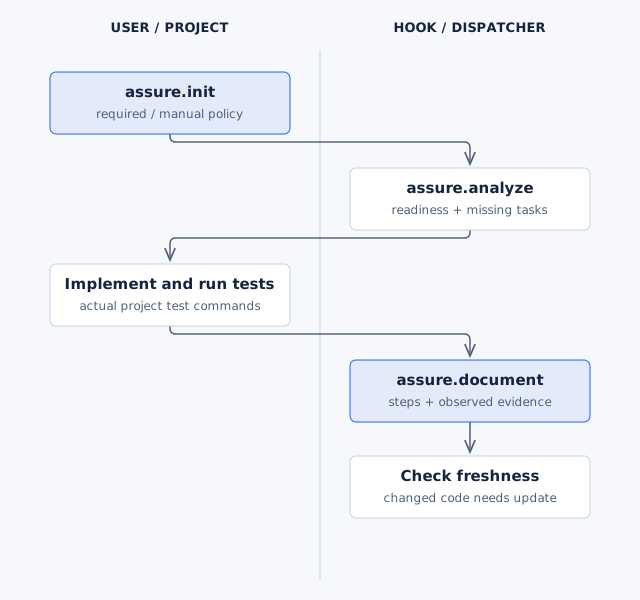
Configured hooks or the managed dispatcher call Analyze and Document. In manual mode you run them yourself. Your project's checks supply the test results; Assure records them. Editable source.
Scripts do the mechanical parts. assure_scan.py detects the projects in the repository and keeps
.github/memory/project-memory.md current: Analyze only reads the result, Document writes it.
It skips the folders under scan.exclude in assure-config.yml, whose default list also covers
.venv, venv, __pycache__, target, vendor, Pods and .gradle. Inside a git work tree it
also skips the folders git ignores. assure_scan.py --check
prints the inventory and the would write line without writing; add --show-block to also print
the memory block. Init keeps an existing assure-config.yml and changes only its three lifecycle
values. audit_qa.py checks the
generated manual for image alt text and captions, broken relative links, the development-only
marker, and secret-shaped values. When Document runs again, the freshness status lists the changed
inputs and outputs, so only the affected parts are rewritten. The documentation-gates.yml CI
check checks out the PR head, not GitHub's merge commit, and runs assure_state.py status --gate,
which skips the check when lifecycle.require_document_before_pr is false. Init replaces an
unedited earlier documentation-gates.yml; for an edited one it prints the ref: line to add.
Limits
- Assure writes test documentation. It does not prove that tests passed.
- A walkthrough goes stale when the implementation changes. Run Document again.
- QA documentation is for testers. It is not the end-user manual.
- The old
qaandhow-to-testextension IDs are retired.
Package details: Assure README.
Stats
Version
Install
Using the Specify CLI
specify extension add assure --from https://github.com/samykabu/sanduq/releases/download/assure-v2.7.5/assure.zip